Guide
Inside a Mold Assessment Report: What to Look For Before You Pay
You have a stained wall and a report on the table, or you are about to buy one. A report is only worth the money if somebody else can act on it. Ask for the measured area, the readings and the water source before you pay. This guide shows what a useful one lists and how you can spot a thin one.
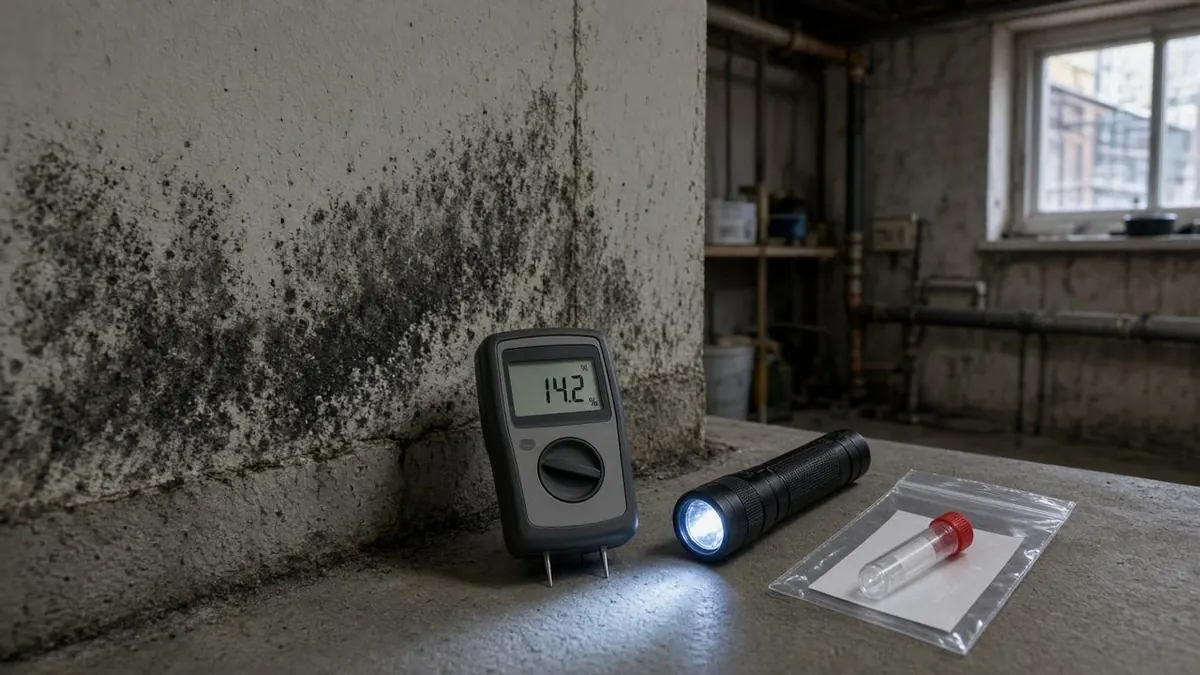
Decide who will read it first
Your report may be read by you, a landlord, a management company, a condo board, an insurer or a housing inspector. Each looks for something different. A landlord looks for the water source. An insurer looks for dates and extent.
Say who the reader is before the visit. It costs nothing, and it changes what gets measured and photographed.
Basis: NJ Department of Health
The rooms and the measured area
A good report goes room by room. It records growth, stains, odor and affected material, and it gives a measured area for each. Ask to see the numbers, not a guess.
Size matters because the Department of Health ties it to the next step. Patches under about 10 square feet can suit a homeowner or building maintenance staff. Past about 100 square feet, it points to a qualified contractor. In between, it asks for a professional opinion. Tell your assessor which of the three you think you have.
Basis: NJ Department of Health, U.S. EPA
Moisture readings, with dates
Mold needs water, so a report with no moisture readings is missing its core. Look for meter readings, taken on a stated date, with a note of where on the wall each one was taken.
Readings usually show wet material reaching beyond the visible stain. Ask how far the wet area goes, and whether it passes through a party wall or a riser chase into a neighbor's space. If it does, someone else has to be told.
Basis: NJ Department of Health
The water source and the repair it needs
The report should name the likely source: a roof or parapet, a riser, a failed seal, a drain that backed up or condensation on a cold surface. It should also say who repairs it, and when.
If the water came through a drain, the report should say so. The Department of Health says sewage in the water adds steps for assessing, cleaning and decontaminating. Check that the scope shows them as separate lines.
The removal scope that contractors bid on
This is the page that saves you money. It sets out areas with quantities, a method per area, the containment, and who must be told before a wall opens.
Send the same page to every contractor. If their quotes follow its lines, you can compare them. If a quote will not itemize against it, ask what it is pricing instead.
When a lab sample belongs in the report
The state health booklet says visible mold needs no extra testing. The EPA adds that no federal limits exist for mold or spores, so a sample cannot check a building against a federal standard.
A sample is worth paying for when the smell has no source you can find, or when a real decision turns on the answer. If the report includes one, ask what it was meant to decide, and choose whether to pay for it.
What a report should not claim
Be wary of a report that passes or fails a home on a spore count, comments on anyone's symptoms, or promises the building will stay clear of mold. The Department of Health says mold can never be ended for good in a building.
Be wary too of an assessor who closes with a price for the removal. The state recommends that the firm which assesses is not the firm that removes. Ask the assessor to confirm in writing that they will not bid.
A quick test of any report
Read the report and ask five questions. Does it list measured areas? Does it give dated readings? Does it name the water source? Does it set out a scope that someone else can price? Does it say who checks the finished work?
If the answer to any of these is no, send it back and ask for the missing part. A report you cannot hand to a contractor or a landlord has not done its job.
If your report is thin
A page that says only that mold was found, with a photo and a price for removal, is a sales sheet. It gives no area to compare and no source to repair. Ask for the measurements and readings behind it.
If the company will not provide them, treat that as your answer. You can ask us to arrange a fresh assessment from a firm that is not bidding on the work.
Reports for renters and condo owners
If you rent, the report should be written so a landlord cannot read it as an opinion. Dated readings, a named source and clear photographs matter most. Attach it to your written notice and keep a copy.
If you own a condo, ask the assessor to note whether the wet area touches a common element. That decides whether the board has to act.
Questions to put to the assessor before the visit
- Will you bid on the removal, or stay out of it?
- What will the report list: areas, readings, source, scope?
- Will you sample, and what decision would a sample change?
- Can the report be written for my landlord or my board?
- Will you come back to check the finished work?
An assessor who answers plainly is usually one who writes plainly. If the answers are vague, ask us for another firm. The report is the one document every other step depends on, so it is worth getting right.
The check after the work
A report is not finished when the removal starts. Ask for a second visit afterward, with fresh readings, photographs of the opened wall and a note that the work matches the scope. It should come from the assessor, not the remover.
Tell us your reader and your room. We arrange the assessment, so the report on your table is one you can use.
Your first booking carries a $100 credit.
- We pay the credit; the contractor's price stays the same.
- Limit of one credit for each customer and each property.
- Expires December 31, 2026.
- Your contractor sets the job price.
The Mold Removal Hoboken pledge
- Asking for help costs nothing and commits you to nothing.
- We take no fee for planning or the introduction.
- We send one company to test and another to remove.
- Your $100 credit is honored exactly as the Terms say.
Your contract with the contractor covers the work itself.
Mold Removal Hoboken, (315) 640-3590 Read the full wording
Tell us who will read your report and what the wall looks like.